Can I Help? Green Screen
A proposal to increase urban shade
CAN I HELP? 008: GREEN SCREEN
Can existing green-cable systems be adapted into smaller, modular shade infrastructure for hot urban spaces?
Green Screen began with a simple observation.
Years ago, while living in Springfield, Missouri, I noticed that downtown had very little shade. On hot summer days, people would gather beneath one of the few mature shade trees available. It seemed less like a landscaping preference than a piece of information: when shade is scarce, people will actively seek it out.
That led to a question:
Could a city create more of that relief in places where planting additional mature trees is difficult?
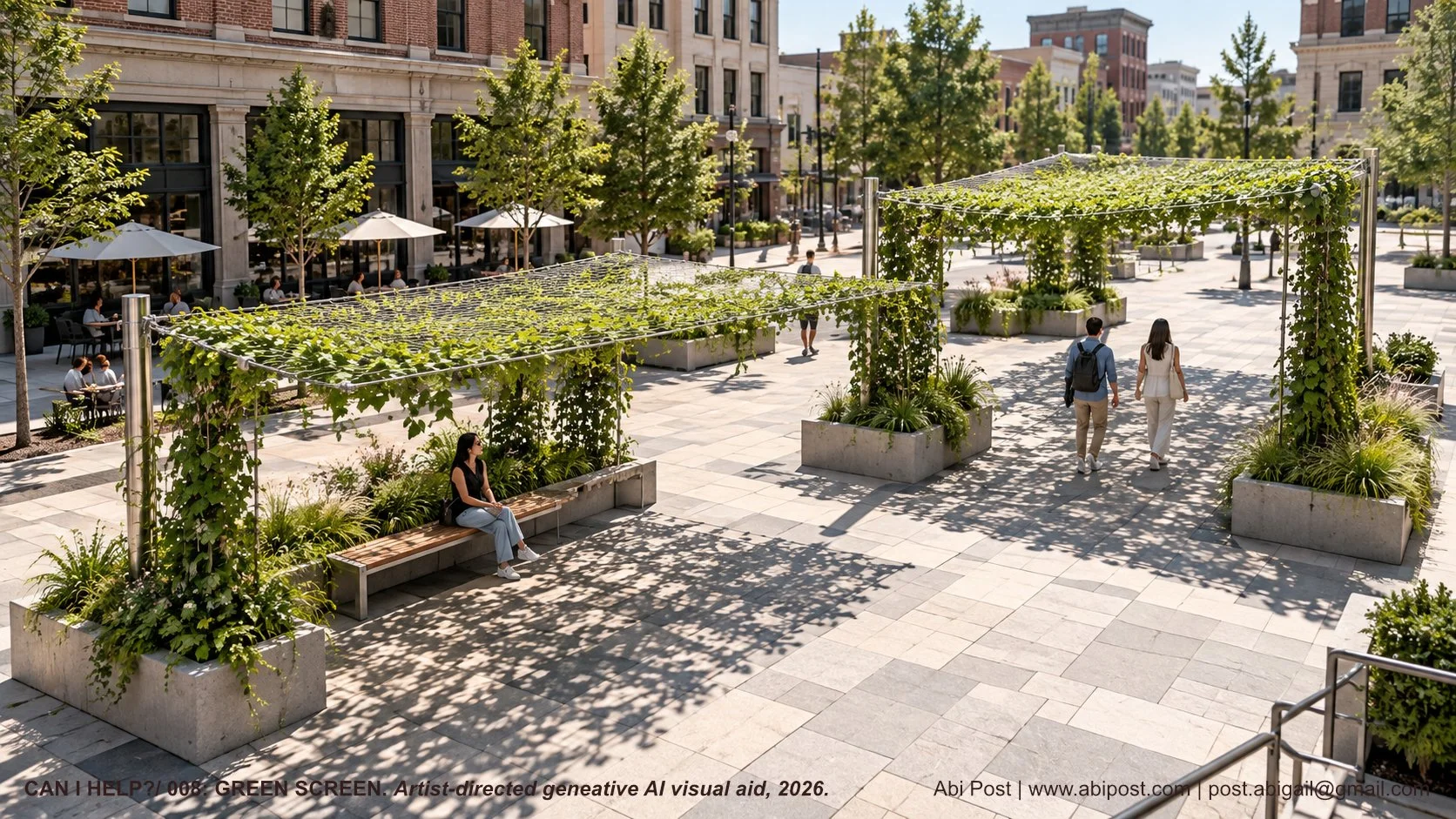
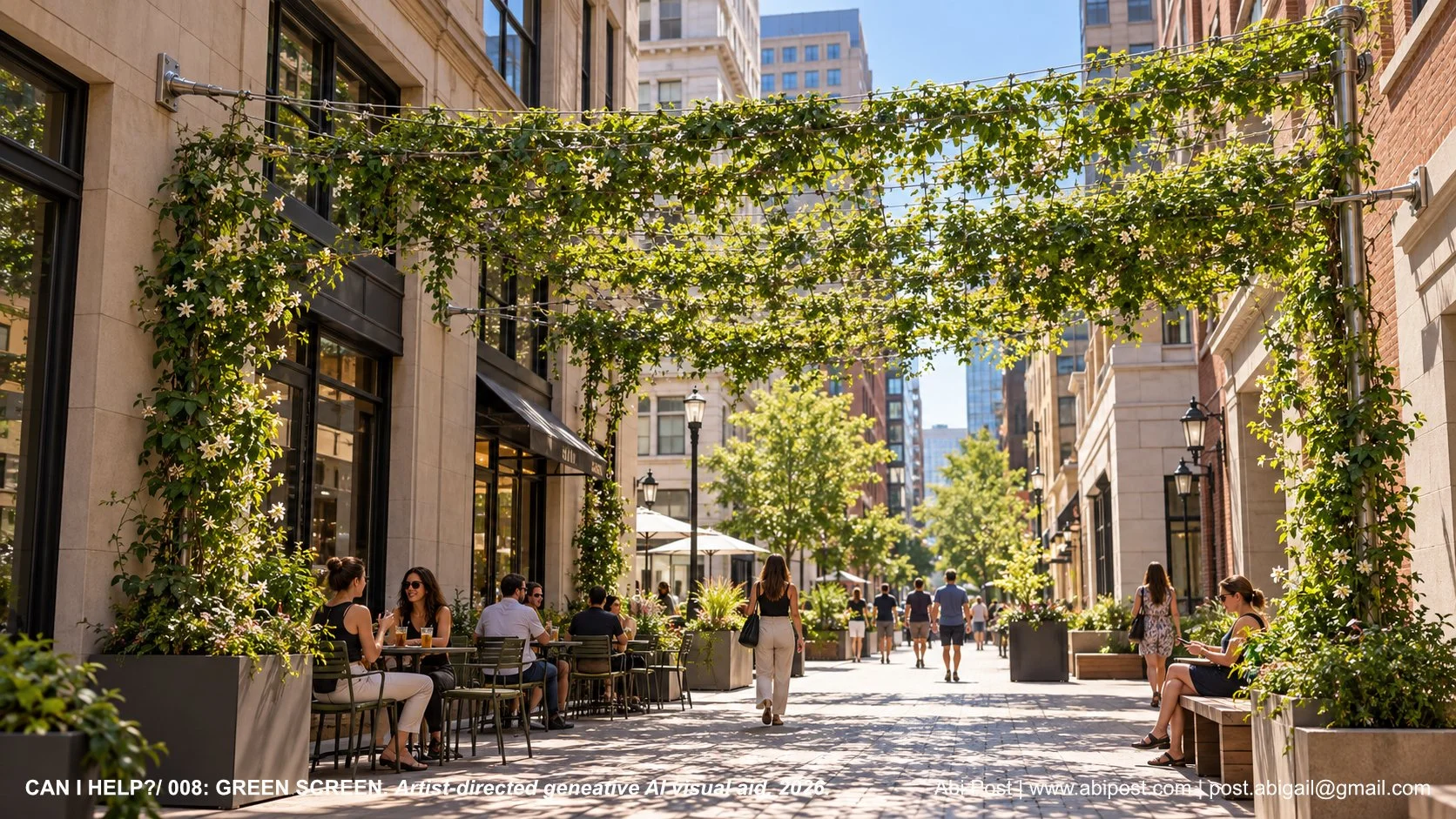
Green Screen explores the possibility of using climbing plants trained across tensioned cable structures to create permeable shade above streets, alleys, courtyards and other paved public spaces.
The idea is not to replace trees, nor to propose a single enormous pavilion. Instead, the project asks whether living shade could become modular and site-specific: perhaps one span in a narrow passage, several across a plaza, or a larger network where conditions allow.
During the development of the project, I discovered that companies such as Jakob Rope Systems have already developed sophisticated cable-supported greening structures and large-scale vegetated shade roofs. Their work demonstrates that the underlying structural and horticultural approach is real, engineered and already in use.
That changed the question.
Rather than asking whether cable-supported vegetation is possible, Green Screen now asks:
Could established systems like these be adapted into smaller, repeatable urban shade modules for places in the United States where pedestrian shade is limited?
The answer may depend entirely on the location. Wind, structural loads, fire access, snow, irrigation, maintenance, plant selection, building ownership and local codes all matter. Those are questions for engineers, horticultural specialists, municipalities and the companies already working in this field.
Green Screen is therefore not presented as a finished engineering solution.
It is a design inquiry:
Where is shade needed?
Where can trees thrive?
Where can they not?
And could another form of living infrastructure help fill some of those gaps?
The goal of CAN I HELP? 008 is to place that question in front of people who know more about these systems than I do, and to see whether there is a useful idea worth developing. Jakob cable would seem to absolutely be the expert in what has been done before. We are hoping the concept can be adapted to create shade in more situations. Our questions are HERE.