Can I Help? You Are Connected
A consumer information model for ground and space connectivity

CAN I HELP 006: You Are Connected
The Question
As direct-to-device satellite connectivity expands, how will ordinary people know what kind of connection they have, what that connection can do, and when their device has moved between ground-based and space-based networks?
The Issue
The Federal Communications Commission is considering a new framework for direct-to-device satellite communications using unlicensed spectrum.
If this technology develops as intended, satellite connectivity may become less of a specialized emergency feature and more of an ordinary part of how consumer devices stay connected.
That creates a user-interface problem.
Today, a phone might show cellular bars, Wi-Fi, “SOS,” a satellite icon, carrier-specific satellite branding, or some combination of those states. Those indicators can tell a user that something is happening without necessarily answering the questions that matter most:
Where is my connection coming from?
What can I do with it?
Is the connection working normally?
The Design Challenge
Consumers should not need to understand satellite telecommunications in order to understand their own phone.
As devices begin moving more seamlessly between terrestrial and satellite networks, the interface should provide a simple, recognizable visual language for those transitions.
This project explores a consumer-facing system organized around three pieces of information:
WHERE?
GROUND / SPACE
WHAT?
Full Data / Limited Data / Messages / Emergency
STATUS?
Connected / Searching / Switching
The goal is not to design the underlying network or prescribe how satellite systems should operate.
The goal is to make the result understandable.
Why It Matters
A satellite connection may look like ordinary connectivity while behaving very differently.
Available services may vary depending on the network, device, location, line of sight, weather, capacity, and other conditions. A strong connection may support messaging but not high-bandwidth data. Emergency access may be available when normal service is not. Some devices may switch automatically between ground and satellite networks without requiring the user to do anything at all.
A traditional signal icon cannot necessarily communicate all of that.
As connectivity becomes more complex, the interface needs to become simpler.
The Proposal
Create a common consumer information structure for direct-to-device connectivity.
At a glance, users should be able to identify:
1. Connection source
Is the device connected through a ground-based network or a satellite network?
2. Available capability
Does the connection support full data, limited data, messaging, calls, or emergency service only?
3. Connection status
Is the device connected, searching for service, or transitioning between network types?
The exact symbols may differ across operating systems, but the meaning should remain consistent.
Existing terms such as SAT may already provide useful shorthand. A broader interface could pair that compact status indicator with plain-language terms such as GROUND and SPACE when users expand their connection information.
A Possible Future
Most people should not have to select “satellite mode.”
Their phone may simply move from:
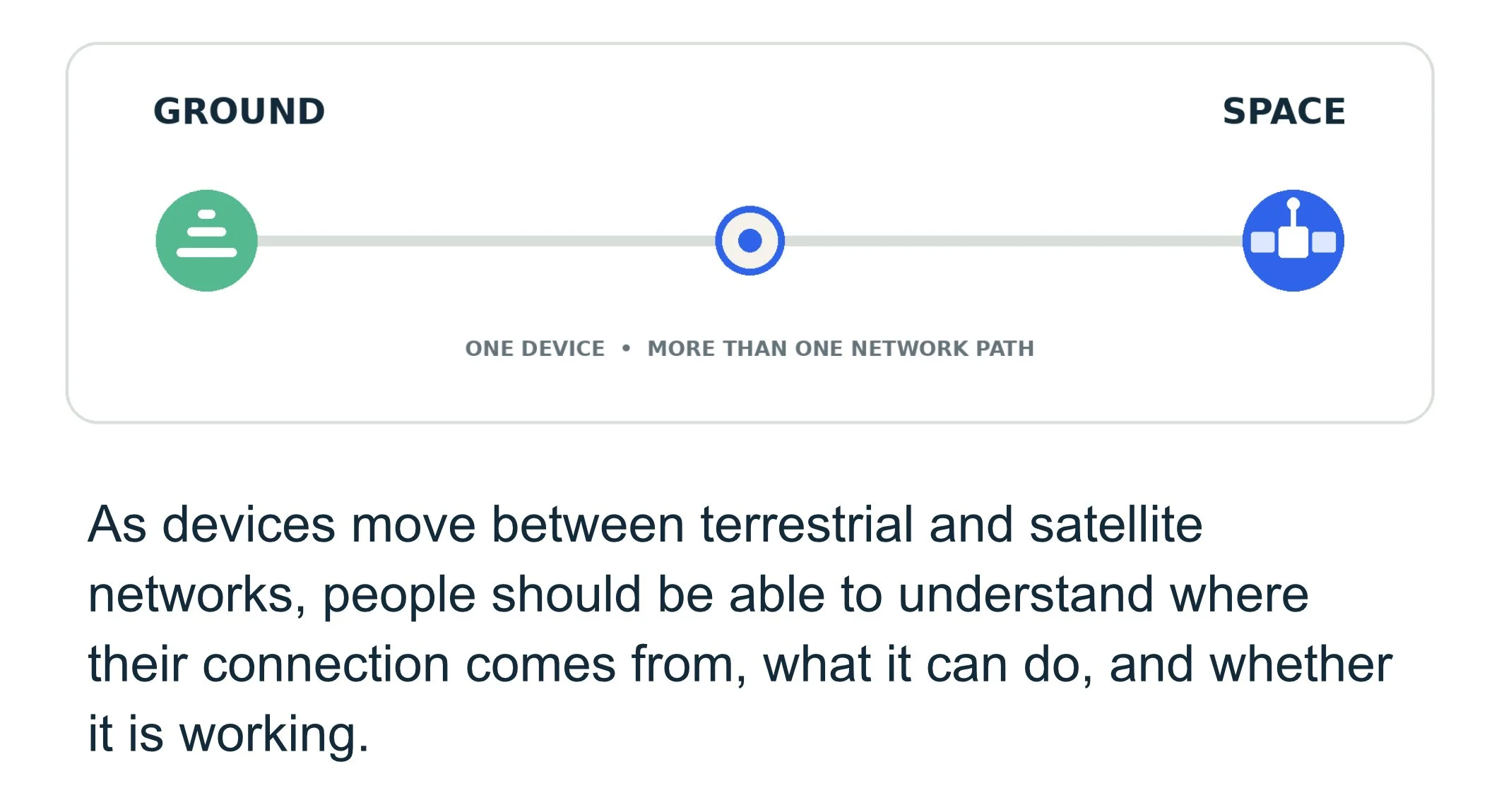
GROUND
to
SPACE
when terrestrial service becomes unavailable or another network path is more appropriate.
If that transition changes what the device can do, the interface should say so clearly.
For example:
SPACE
Connected
Messages ✓
Calls ✓
Data Limited
The underlying network may be extraordinarily complex.
The user experience does not have to be.
The Ask
As the FCC develops rules for expanded direct-to-device satellite communication, consumer transparency should be considered alongside technical compatibility and interference management.
Industry standards bodies, operating-system developers, carriers, device manufacturers, and regulators should work toward a recognizable cross-platform language for satellite connectivity.
The objective is simple:
A person should always be able to understand where their connection is coming from, what it can do, and whether it is working.
CAN I HELP?
Ubiquitous connectivity only works if people understand the connection they have.
FCC Proceeding: ET Docket No. 26-169
Project: CAN I HELP? 006 — YOU ARE CONNECTED
FOR THE FULL PRESENTATION, CLICK HERE
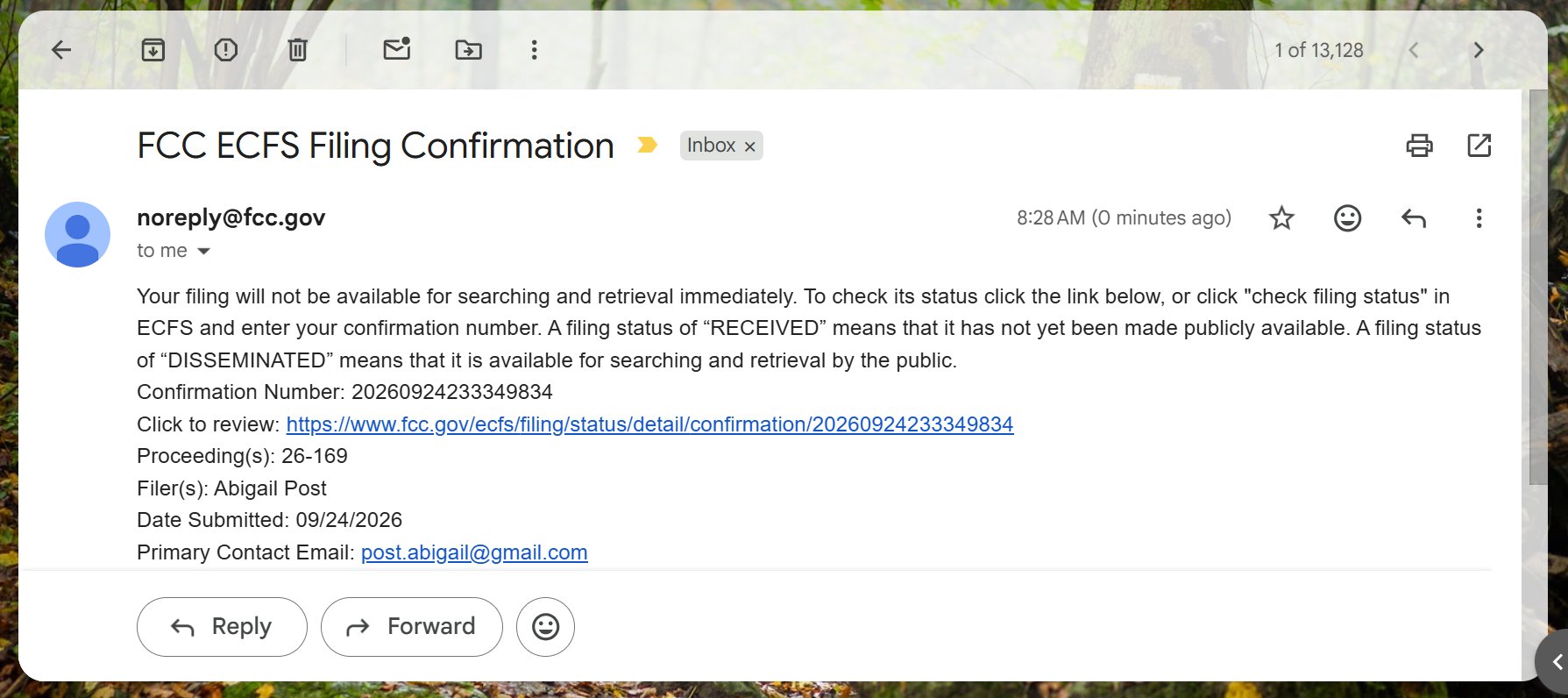
This is the confirmation that the ECFS sends after a successful upload. Comments are later searchable by docket number.